Jiufen Tea Houses: A-Mei, Best Views and the Spirited Away Myth
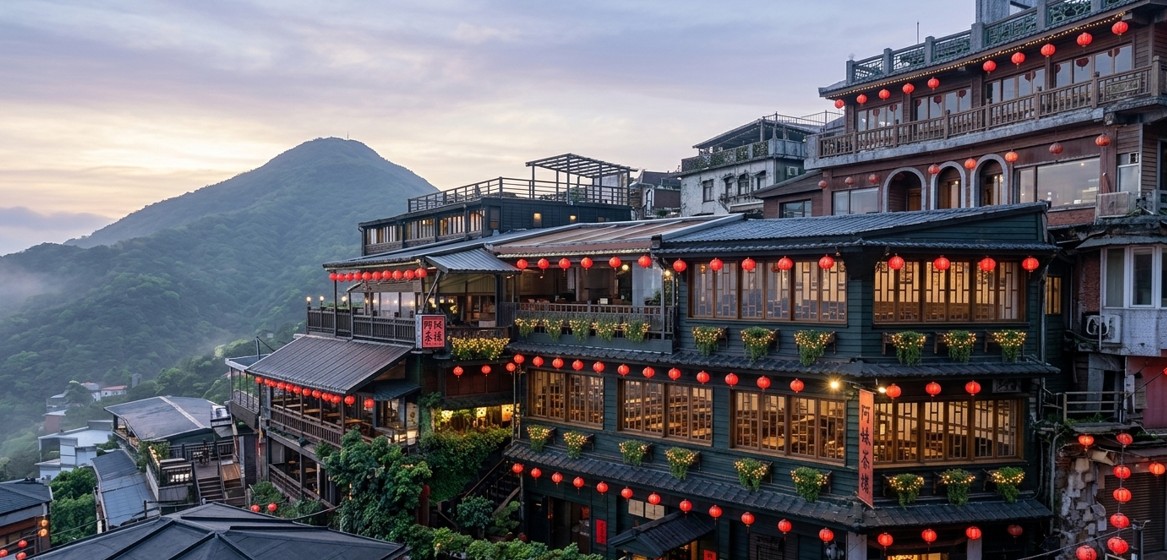
The teahouses are the reason Jiufen looks the way it does in every photo. Perched on the stone steps of Shuqi Road, their red lanterns and wooden balconies look out over the East China Sea, and sitting down for a pot of tea as the light fades is the classic Jiufen experience. This guide covers which teahouse to choose, what a tea set actually costs and involves, and the truth about the famous link to a certain animated film.
Which is the famous Jiufen tea house?
The famous one is the A-Mei Tea House (阿妹茶樓), the century-old teahouse on Shuqi Road whose lantern-covered wooden facade appears in almost every picture of Jiufen. It is the most photographed building in town.
A-Mei sits on the steep stairway at the heart of the Old Street, its dark timber frame strung with red lanterns that glow from late afternoon. It is beautiful, and it knows it: expect crowds on the steps outside and a wait for a balcony seat at peak times. It is not the only teahouse, though, and for some visitors not even the best one, which is where a little planning pays off.
Is Jiufen really the inspiration for Spirited Away?
No, not officially. Jiufen is often said to have inspired the bathhouse in Studio Ghibli’s Spirited Away, but director Hayao Miyazaki and the studio have denied any direct link. The resemblance is real, the connection is a myth.
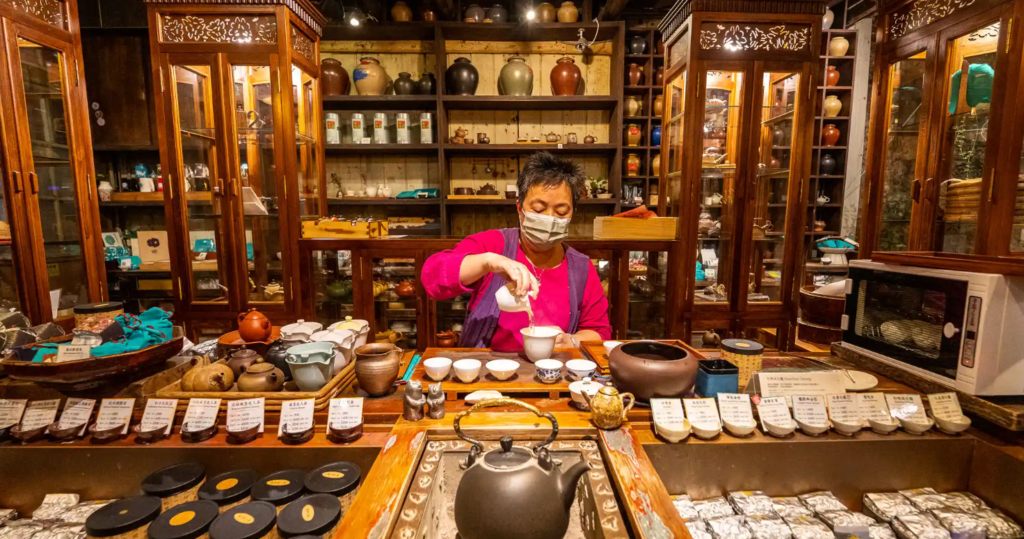
It is easy to see why people make the leap. The lantern-lit timber buildings stacked up the hillside do look like the world of the 2001 film, and the story has been repeated so often that many visitors arrive certain it is fact. It is worth knowing the truth so you are not chasing a “Spirited Away tea house” that does not exist. If you love the Ghibli aesthetic, you will still enjoy Jiufen enormously; just go for the place itself.
The real cultural anchor is closer to home. Jiufen’s revival came from A City of Sadness, the 1989 film by Taiwanese director Hou Hsiao-hsien, which was set here and won the Golden Lion at Venice. That film, not a Japanese animation, is what brought the crowds back to these lanes and made the teahouses what they are today. You can read more about the studio’s own work on the official Studio Ghibli site.
Expert tip from Joanne Liao, our editor and heritage writer: “When people ask me for the Spirited Away teahouse, I gently set them straight, then point them up the steps anyway. The magic they are after is genuinely here at dusk. It just came from a Taiwanese film, not a Japanese one, and knowing that makes the visit richer, not poorer.”
Joanne Liao
The main Jiufen teahouses, compared
Three teahouses cover most visits, and they trade off fame, calm, and view. A-Mei is the icon, Jiufen Tea House is the quiet one, and the viewpoint teahouses higher up have the cleanest outlook.
| Teahouse | View | Atmosphere | Tea set (per person) | Best for |
|---|---|---|---|---|
| A-Mei Tea House (阿妹茶樓) | Lantern facade, busy balcony | Iconic, crowded, photogenic | ~NT$300 to 450 | The classic scene and first visits |
| Jiufen Tea House (九份茶坊) | Quieter terrace | Refined, calm, art-filled heritage house | ~NT$300 and up | A relaxed, proper tea ritual |
| Skyline and upper teahouses | Open sea-and-mountain panorama | Modern, less famous, fewer crowds | ~NT$250 to 350 | The best uninterrupted view |
What is a Jiufen tea set, and what does it cost?
A Jiufen tea set is a brew-your-own ritual: you pay roughly NT$300 to NT$450 per person and get a pot of leaves, hot water on demand, and a plate of small snacks. There is usually a minimum charge per guest.
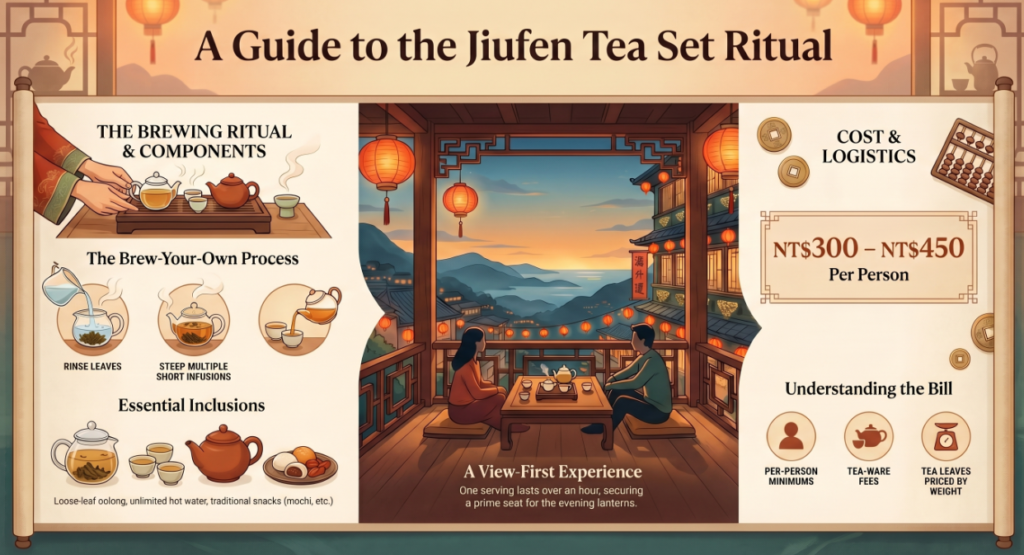
The staff set you up with a tray, a small clay or porcelain pot, and a tea boat, then show you the basics. You rinse the leaves, steep short infusions, and keep topping up the hot water, so one serving of leaves lasts a long, slow hour or more. It is less about drinking quickly and more about holding a table with a view while the lanterns come on.
- What you get: loose-leaf tea (often local oolong), unlimited hot water, and snacks such as sesame crackers, dried plum, and mochi.
- What to expect on the bill: a per-person minimum, sometimes a small tea-ware or seating charge, and the leaves priced by weight.
- What it buys you: a balcony seat for as long as you like, which at peak times is worth the price on its own.
Which teahouse has the best view?
For the cleanest sea-and-mountain panorama, the teahouses higher up Shuqi Road beat A-Mei, whose own view is partly of the famous steps and the crowd on them. For atmosphere, A-Mei still wins.
It comes down to what you want. A-Mei gives you the scene, the lanterns, and the buzz, but your balcony looks onto a river of other visitors. Climb a little higher and the upper teahouses open onto the bay and the green ridges with far fewer heads in the way. That is the trade-off: the most famous balcony is not the best vantage point. For where to actually stand with a camera, see our guide to Jiufen’s best photo spots, and for the lanterns after dark, our guide to Jiufen at night.
Expert tip from Joanne Liao, our editor and heritage writer: “Order tea before 5pm to claim a balcony, then simply stay. The same seat that costs you a wait at 4:30 becomes the best spot in Jiufen at 6, when the day-trippers leave and the lanterns are lit. You are not buying tea so much as renting the view at the perfect hour.”
Joanne Liao
How to have the best teahouse experience
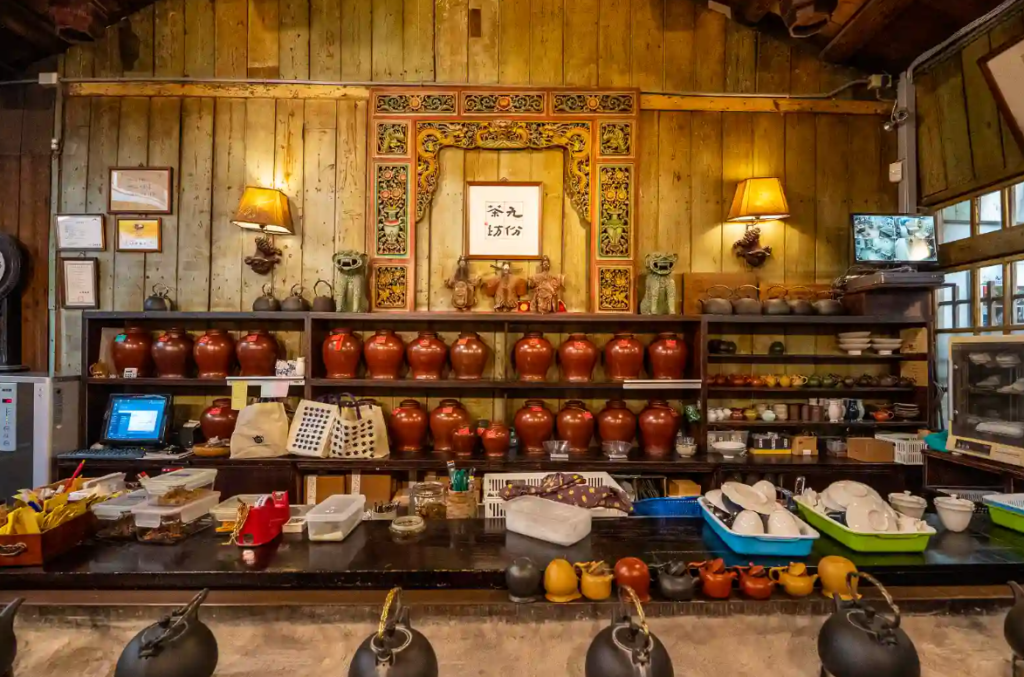
A little timing turns a rushed, pricey stop into the highlight of the trip. Follow this simple order.
- Arrive in the late afternoon, before the dusk rush, while balcony seats are still open.
- Choose your priority first: the iconic facade and buzz at A-Mei, the calm at Jiufen Tea House, or the clean view higher up.
- Order a tea set, settle in, and let the staff refill your hot water; there is no rush to leave.
- Stay through the moment the lanterns come on, then walk the steps once the light goes blue.
Most teahouses do not take bookings for small groups, so the seat is won by arriving early, not by reserving. For background on Taiwanese tea culture and the wider region, the Taiwan Tourism Administration is a useful starting point.
Common questions about Jiufen’s tea houses
Is the A-Mei Tea House worth it?
Yes, for the atmosphere and the photo, as long as you accept the crowds. If you mainly want a quiet view, an upper teahouse gives you more for a little less.
Do you need a reservation for a Jiufen tea house?
Usually no. Most teahouses seat walk-ins only, so the way to secure a balcony at dusk is to arrive in the late afternoon rather than to book ahead.
Can you just buy a single drink?
Sometimes, but most teahouses set a per-person minimum, so two people sharing one tea set may be asked to order more. Budget for the minimum charge rather than a single cheap cup.
Is A-Mei the Spirited Away tea house?
No. People call it that because of the resemblance, but Studio Ghibli has denied that Jiufen inspired the film. A-Mei is famous in its own right, and sits on the Old Street you walk to reach it.
Written by Joanne Liao, our editor and heritage writer. Joanne grew up between California and Keelung, with family near Jiufen, and covers the town’s teahouses, history, and film legacy.