
Jiufen Old Street: Things to Do, Map and Tips

Jiufen Old Street is the heart of the town: a tangle of stair-lined market lanes at the centre of Jiufen, a former gold-mining town in Ruifang District, New Taipei City. It is where almost everyone spends their visit. Two streets do most of the work, the covered snack lane and the famous teahouse stairway, and once you understand how they cross, the whole place stops feeling like a maze. This guide explains what the Old Street is, how it is laid out, the best things to do along it, and how long to give it.
What is Jiufen Old Street?
Jiufen Old Street is the network of narrow pedestrian lanes at the centre of the old gold town, packed with snack stalls, teahouses, and souvenir shops. It is the main reason most people come to Jiufen.
The streets were built in the gold-rush years, when Jiufen boomed as one of Asia’s richest mining towns under the Japanese colonial era. After the mines closed the town faded, until the 1989 film A City of Sadness, directed by Hou Hsiao-hsien, made these lanes famous across the Chinese-speaking world and brought visitors flooding back. Today the red lanterns, stone steps, and tea sets you see in every photo of Taiwan are right here, layered over a working town that still sells groceries to the people who live above the shops.
How is the Old Street laid out?
Two streets form a cross. Jishan Street (基山街) is the long, covered shopping and snack lane, and Shuqi Road (豎崎路) is the steep stone stairway that drops down across it, lined with teahouses.
Get those two names straight and you can navigate the whole Old Street. Jishan Street runs roughly level along the hillside and is so tightly roofed with awnings that locals nicknamed it the “Dark Street” (暗街仔), because daylight barely reaches the lane. Shuqi Road is the opposite: an open flight of stone steps climbing the slope, where the teahouses, red lanterns, and the view out to the East China Sea make the scene everyone pictures. They meet near the middle, so a good visit is simply walking one, then the other.
| Street | Character | What you will find | Best for |
|---|---|---|---|
| Jishan Street (基山街) | Narrow covered “Dark Street” lane | Snack stalls, souvenir shops, taro balls, tea sellers | Eating, browsing, buying gifts |
| Shuqi Road (豎崎路) | Steep open stone stairway | Teahouses, red lanterns, sea-and-rooftop views | Photos, tea, the classic Jiufen scene |
The best things to do on Jiufen Old Street
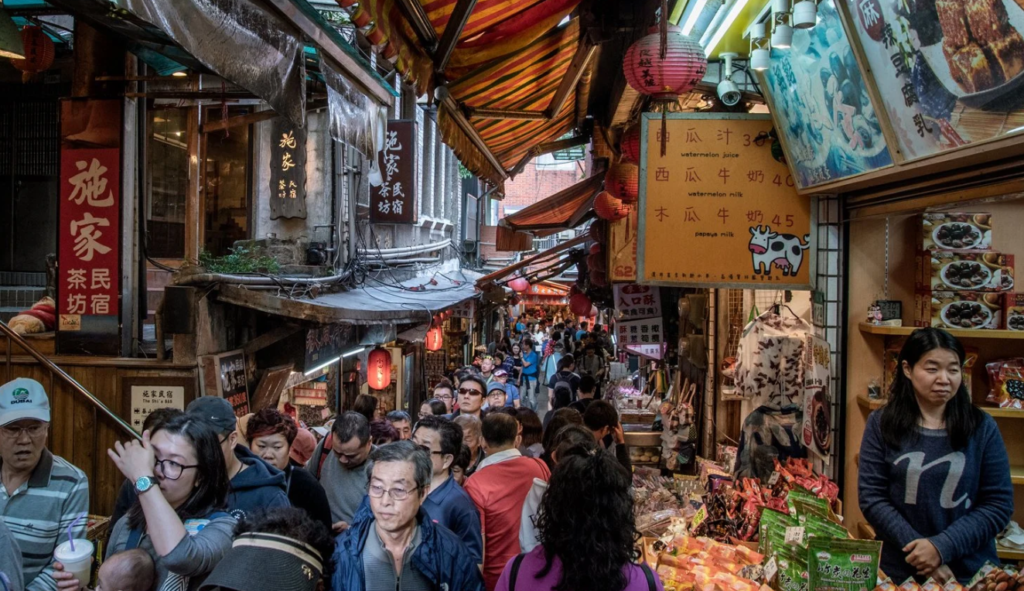
Beyond eating and browsing, a handful of landmarks are worth slowing down for. None takes long, and most are free or cheap.
- Shengping Theatre (昇平戲院). One of Taiwan’s oldest cinemas, restored with vintage seats and film posters. Entry is free, and it is a quiet break from the crowds.
- The Shuqi Road stairway. The picture-postcard steps, best near dusk when the lanterns glow. More on timing this in our guide to Jiufen at night.
- A-Mei Tea House (阿妹茶樓). The century-old teahouse with the famous lantern-covered facade on the steps. We cover it fully in our guide to Jiufen’s tea houses.
- Ghostlore Jiufen. A small haunted-house museum off the lanes, around NT$150, good for a quick thrill if you are travelling with teens.
- The local temples. Small shrines such as Mingsheng Temple sit just above the lanes, a reminder that this is a real neighbourhood, not a stage set.
If you have an extra hour, the Gold Museum at Jinguashi, the next valley over, tells the mining story that built Jiufen and is a short bus ride away. It sits outside the Old Street itself, so treat it as an add-on rather than part of the walk.
Expert tip from Joanne Liao, our editor and heritage writer: “Walk all the way to the quiet end of Jishan Street before you start buying. The first hundred metres from the bus stop are the most crowded and the most expensive. Ten minutes deeper in, the same taro balls and nougat cost less and you can actually see the shop you are standing in.”
Joanne Liao
What can you buy and eat on the Old Street?
Food first, souvenirs second. Jishan Street is a string of snack stalls, and the local specialities are cheap, filling, and best eaten as you walk.
- Taro balls (芋圓), Jiufen’s signature dessert, served hot in winter or over shaved ice in summer.
- Savoury snacks: fish ball soup, grilled sausages, peanut ice cream rolls, and herbal pork.
- Edible souvenirs: pineapple cakes, nougat, dried mushrooms, and loose-leaf tea to take home.
For a full rundown of the dishes worth queuing for and rough prices, see our guide to what to eat in Jiufen. On the souvenir side, prices drop the further you get from the entrance, so browse before you commit.
How do you walk the Old Street without backtracking?
Follow a simple loop: enter along Jishan Street, eat your way through, then drop down the Shuqi Road steps. That way you see both streets once and finish at the photogenic stairway.
- Start at the Jishan Street entrance near the main bus stop and the 7-Eleven, where almost everyone arrives.
- Walk the covered lane slowly, sampling snacks and browsing shops as you go.
- Where Jishan Street crosses Shuqi Road, turn and head down the stone steps past the teahouses.
- Finish with tea on the steps as the lanterns come on, then climb back up to the bus stop, or carry on down toward Ruifang.
How much time do you need on Jiufen Old Street?
Most visitors spend two to three hours on the Old Street. Add a teahouse stop and time for photos at dusk and it easily fills an afternoon and early evening.
If you are only walking the lanes and grabbing a few snacks, ninety minutes is enough. Sit down for a proper tea set on Shuqi Road and you will want closer to three hours. If you are still deciding whether the trip earns its travel time, our honest take on whether Jiufen is worth it weighs it up.
Expert tip from Joanne Liao, our editor and heritage writer: “The Old Street changes character by the hour. Late morning it belongs to the tour coaches, mid-afternoon it eases, and after the last buses leave it becomes almost peaceful under the lanterns. If you can, time your visit so you are walking down Shuqi Road just as the light goes blue.”
Joanne Liao
When is the Old Street busiest?
Crowds peak with the tour buses between about 10am and 4pm, and weekends and Taiwanese holidays are busiest of all. Early morning and the hour after the day-trippers leave are the calmest.
The lane can slow to a shuffle at midday, then empties as stalls begin closing in the evening, so a late visit is peaceful but with fewer shops open. For exact opening hours, the weather, the seasons, and how to dodge the worst of the crowds, see our guide to the best time to visit Jiufen. You can also read more about the official mining heritage at the New Taipei City Gold Museum, or browse regional travel basics on the Taiwan Tourism Administration site.
Common questions about Jiufen Old Street
Is there an entrance fee for Jiufen Old Street?
No. The Old Street is free to walk. You only pay for food, souvenirs, teahouses, and small paid attractions like the Ghostlore museum.
Is Jiufen Old Street the same as a night market?
Not quite. It has the snack-stall feel of a night market but is a permanent old street that runs through the day and winds down in the evening, rather than a market that only opens at night.
Is Jiufen Old Street wheelchair or stroller friendly?
It is challenging. Jishan Street is mostly level but very narrow and crowded, while Shuqi Road is a long flight of stone steps with no ramp. Travellers with mobility needs can still enjoy the covered lane but should expect to skip the stairway.
Where does Jiufen Old Street start?
At the top entrance to Jishan Street, beside the main bus stop and convenience store where buses from Taipei and Ruifang drop you. Our guide on how to get to Jiufen from Taipei covers getting to that stop.
Written by Joanne Liao, our editor and heritage writer. Joanne grew up between California and Keelung, with family near Jiufen, and covers the town’s teahouses, history, and film legacy.